臺灣原住民族

( ontheworldmap.com )

Also shown are:
Green Island (Lu Dao) & Orchid Island (Lan Yu).
( cia.gov )

( nouahsark.com )

Highland Peoples.
Alternate spellings or names:
Taroko (Truku, Seediq); Yami (Tao)
( wikipedia . org )

( geology . com )
* * * * *
Click here to return to the CloudBridge Home Page
for Language & Peoples of Taiwan
Indigenous Peoples of Taiwan – 臺灣原住民族
- Indigenous Peoples on the Island of Taiwan ( 臺灣原住民族 ) were formerly referred to as “Taiwanese Aborigines”. Traditionally, the Indigenous Peoples of Taiwan have been classified into two groups by their places of residence. The bulk of contemporary Indigenous Peoples of Taiwan reside in their traditional mountain villages, and increasingly in Taiwan’s urban areas. They are referred to as “Highland Peoples”. There are also the Plains Indigenous Peoples, who have always lived in the lowland areas of the island.
- The Indigenous Peoples of Taiwan are identified according to nationally-recognized subgroups. The government of the Republic of China on the Island of Taiwan officially recognizes distinct people groups among the indigenous community based upon the qualifications drawn up by the Council of Indigenous Peoples (CIP). The government presently officially recognises sixteen ethnic groups of indigenous peoples. Currently fifteen of the officially-recognized tribes are Highland Peoples. These groups primarily inhabit the eastern half of Taiwan, which consists mostly of mountainous terrain.
- The population of the officially-recognized indigenous groups is approximately 600,000 persons, or 3% of the island’s population. The estimate of total population of indigenous peoples on the Island of Taiwan increases to more than 800,000 if the indigenous peoples of the Plains in Taiwan are included, pending future official recognition by the government. If persons of mixed ancestry are included in the population estimate, then the number rises to possibly more than one million persons.
- Academic research suggests that the ancestors of the Indigenous Peoples have been living on Taiwan for approximately 15,000 years. A wide body of evidence suggests that the Taiwanese Indigenous Peoples had maintained regular trade networks with numerous regional cultures of Southeast Asia before the Han Chinese began to settle on the Island of Taiwan in the 17th century.
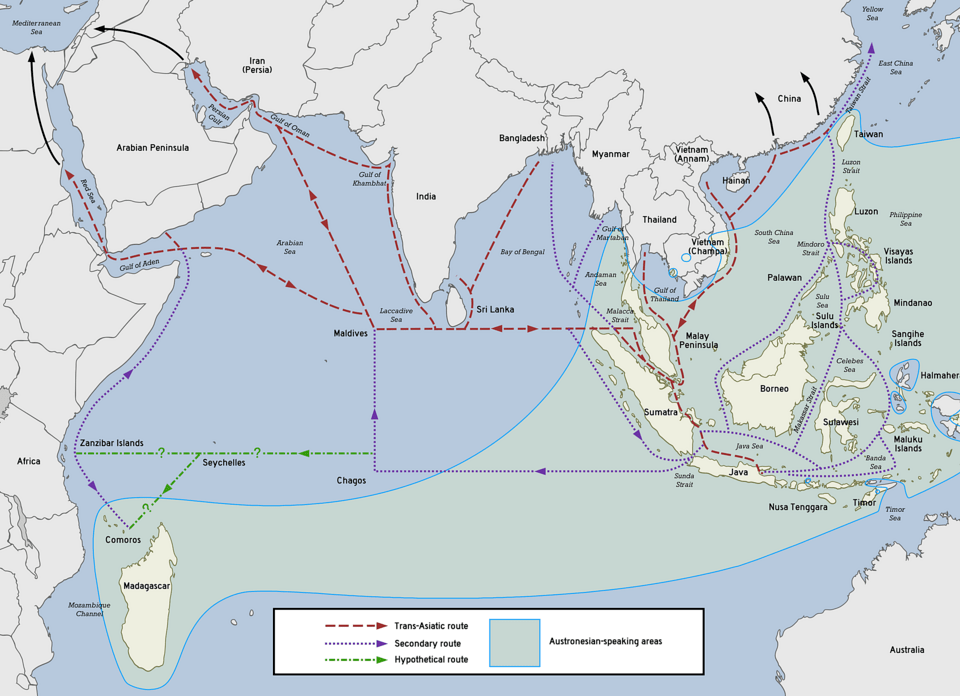
historic maritime trade network in the Indian Ocean
( Wikipedia . org )
- In English, the Indigenous Peoples of Taiwan have also been called “Formosans”, “Native Taiwanese” & “Austronesian Taiwanese”. The name “Gaoshan” is also the official label in the Peoples’ Republic of China for all Indigenous Taiwanese, although Indigenous Taiwanese people dislike this label since the term “Gaoshan” means “high mountain” and it disregards those Indigenous Peoples who inhabit the Coastal Plains on the Island of Taiwan.
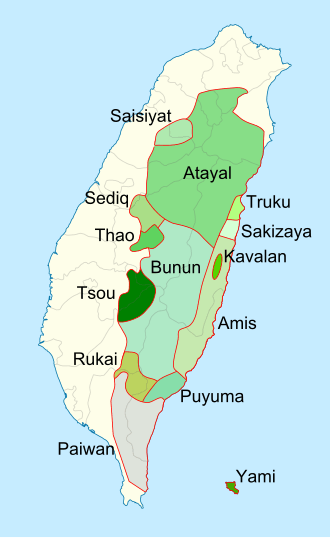
( wikipedia . org )
( geology . com )
- The earliest detailed records dating from the arrival of Dutch explorers in 1624 describe the indigenous peoples as living in independent villages of varying sizes. There was frequent trade between the villages, as well as intermarriage, warfare & alliances against common enemies. There was an early understanding by the Dutch explorers that the indigenous people groups had separate tribal structures, aristocracies & and social heirarchies.
- Taiwanese indigenous peoples are Austronesians, with linguistic, genetic & cultural ties to other Austronesian peoples. The Island of Taiwan is considered to be the place of origin & linguistic homeland of the Oceanic Austronesian Expansion. The descendant groups of the Indigenous Peoples of Taiwan today include the majority of the ethnic groups throughout many parts of East & Southeast Asia, as well as Oceania & even Africa. Modern countries & regions populated by Austronesian peoples include: Brunei, EastTimor, Indonesia, Malaysia, Madagascar, Philippines & the regions of Micronesia, Melanesia & Polynesia.
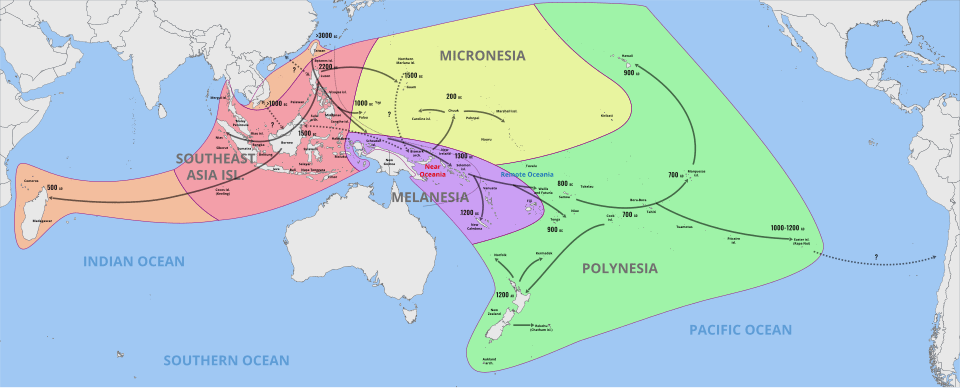
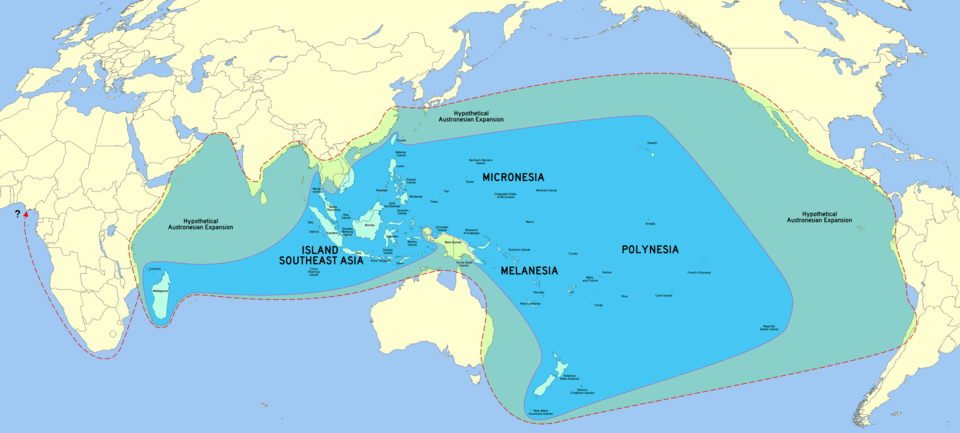
& possible further migrations & contact (in Green)
( Wikipedia . org )
- For centuries, Taiwan’s indigenous inhabitants experienced economic competition and military conflict with a series of colonizing newcomers. Centralized government policies designed to foster language shift & cultural assimilation, as well as continued contact with the colonizers through trade, inter-marriage & other intercultural processes, have resulted in varying degrees of language death & loss of original cultural identity for the Indigenous Peoples of Taiwan. For example, of the approximately 26 known languages of the Indigenous Peoples of Taiwan (collectively referred to as “the Formosan languages”), at least ten are now extinct, five are moribund & several are to some degree endangered. These languages are of unique historical significance since most historical linguists consider Taiwan to be the original homeland of the Austronesian languages. All of its primary branches of the family of Austronesian languages, except for Malayo-Polynesian, exist only on Taiwan.
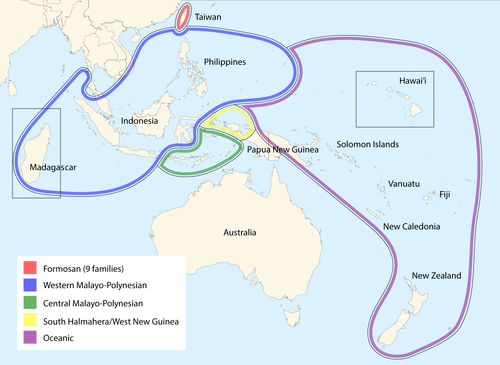
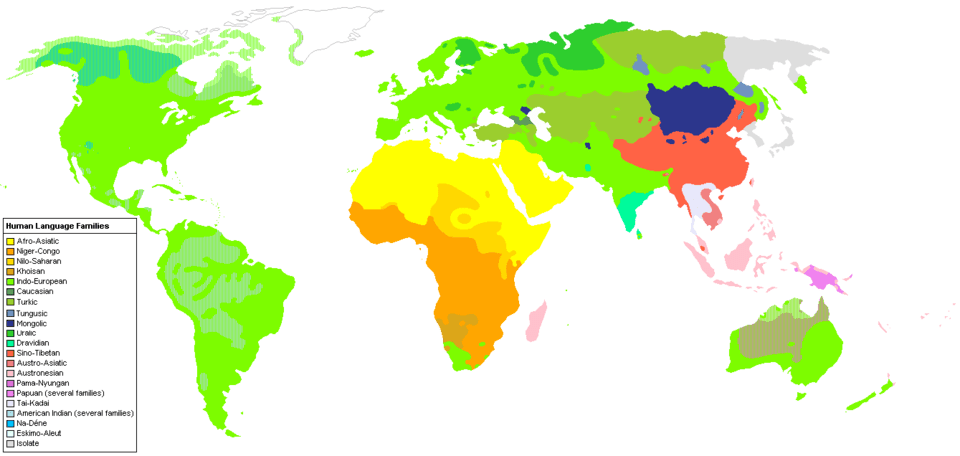
(shown in light rose pink) ( Wikipedia . org )
- cip.gov.tw – The website of the Council of Indigenous Peoples (CIP) of the Island of Taiwan
- cip.gov.tw – The Tribes of Taiwan @ The website of the Council of Indigenous Peoples (CIP) of the Island of Taiwan
- wikipedia.org – Council of Indigenous People of Taiwan @ Wikipedia . org
- tacp.gov.tw – Indigenous peoples of Taiwan @ Indigenous Peoples Cultural Development Center website
- taiwan.gov.tw – Indigenous People @ Taiwan . gov . tw
- tipp.org.tw -Taiwan Indigenous Peoples Portal
- ab.hl.gov.tw – Introduction to the Tribes @ Indigenous Peoples Department of Hualien County government website
- knowledge.gov.taipei – The Sixteen Clans @ Taiwan Indigenous Peoples Cultural Knowledge Network
- wikipedia.org – Government Information Office, Executive Yuan (行政院新聞局) @ Wikipedia . org.
- mofa.gov.tw – Government Information Portal @ Republic of China Ministry of Foreign Affairs website
- wikipedia.org – Demographics of Taiwan @ Wikipedia . org
- wikipedia.org – Taiwanese People @ Wikipedia . org
- wikipedia.org – Austronesian peoples @ Wikipedia . org
- wikipedia.org – Austronesian peoples migration from Taiwan @ Wikipedia . org
- wikipedia.org – Indigenous Peoples of Taiwan ( 臺灣原住民 ) @ Wikipedia . org
- wikipedia.org – List of Indigenous peoples of Taiwan @ Wikipedia . org
- wikipedia.org – Indigenous Areas of Taiwan @ Wikipedia . org
- wikipedia.org – Plains Indigenous Peoples of Taiwan @ Wikipedia . org
- wikipedia.org – Shung Ye Museum of Formosan Aborigines – 順益臺灣原住民博物館 @ Wikipedia . org
- images.google.com – Formosan Aborigines – photographs @ Google Images
- wikipedia.org – Austronesian languages @ Wikipedia . org
- wikipedia.org – List of Austronesian Languages @ Wikipedia . org
- wikipedia.org – Formosan languages @ Wikipedia . org
- wikipedia.org – Malayo-Polynesian languages @ Wikipedia . org
- wikipedia.org – Languages of Taiwan @ Wikipedia . org
- wikipedia.org – Pre-History of Taiwan @ Wikipedia . org
- wikipedia.org – History of Taiwan @ Wikipedia . org
- nlpi.edu.tw – Indigenous Learning Resources @ Taiwan National Library of Public Information website
- nlpi.edu.tw – Mother Tongue Nest of the Taipei City Government Indigenous Peoples Affairs Commission @ Taiwan National Library of Public Information website
- tipp.org.tw -Taiwan Indigenous Peoples Portal
- maolin-nsa.gov.tw
- iwgia.org
- taiwantoday.tw
- culturalsurvival.org
- ipc.gov.taipei
- melbourneasiareview.edu.au
- wtfna.org
- cos.io
- taiwanobsessed.com – NIne Meaningful Ways to Experience Indigenous Culture in Taiwan @ Nick Kembel’s “Taiwan Obsessed” website (Terrific site !!)
- explorethesun.tw
- minorityrights.org
- cwis.org
* * * * *
THE INDIGENOUS PEOPLE GROUPS – 原住民族
- In the early 1910’s, research in the Japanese era of occupation recognized nine ethnic groups among the Indigenous Peoples on the Island of Taiwan: Amis, Atayal, Bunun, Paiwan, Puyuma, Rukai, Saisiyat, Tsou & Yami.
- In the early 2000’s, revitalization of indigenous cultural movements influenced the government to change its attitude towards the Indigenous People of Taiwan. The Yami people were renamed to Tao. New ethnic groups were also recognized by the government, including Thao in 2001, Kavalan in 2002, Truku (Taroko) in 2004, Sakizaya in 2007, Seediq in 2008, Kanakanavu in 2014, and Saaroa in 2014.
- Currently, the government of the Republic of China on the Island of Taiwan officially recognizes these sixteen ethnic groups of indigenous peoples (原住民族).
- Three additional People Groups are “locally recognized”, and additional People Groups are “unrecognized”.
- THE COUNCIL of INDIGENOUS PEOPLES – 原住民族委員會
- The government of the Republic of China (ROC) on the Island of Taiwan officially recognizes groups among the indigenous peoples based on qualifications drawn up by the Council of Indigenous Peoples (CIP). To gain this recognition, communities must gather a number of signatures & a body of supporting evidence in order to successfully petition the CIP for recognition. Formal recognition confers certain legal benefits & rights upon a group, as well as providing them with the satisfaction of recovering their separate identity as an ethnic group.
- The CIP is the State agency responsible for Indigenous Peoples. Taiwan has adopted a number of laws designed to protect Indigenous Peoples’ rights, including: (i) Constitutional Amendments on Indigenous Representation in the Legislative Assembly; (ii) protection of language, culture & political participation (2000); the Indigenous Peoples’ Basic Act (2005); the Education Act for Indigenous Peoples (2004); the Status Act for Indigenous Peoples (2001); the Regulations regarding Recognition of Indigenous Peoples (2002); the Name Act (2003), which allows Indigenous Peoples to register their original names in Chinese characters & to annotate them in Romanized script; and the Indigenous Languages Development Act (2017).
- Regrettably, there are discrepancies & contradictions that have been recognized in some of the recent legislation & there has been less-than-complete implementation of some aspects of the laws. This has delayed progress towards full self-governance for all of the Indigenous People Groups who recognize themselves on the Island of Taiwan. Since Taiwan is not a member of the United Nations, it is not party to UN human rights instruments which could otherwise be used to improve the outcome.
- Source: IWGIA.org – The Indigenous World 2024: Taiwan @ IWGIA – International Work Group for Indigenous Affairs – a global human rights organisation dedicated to promoting & defending Indigenous Peoples’ rights).
- At the present time, the government officially recognises sixteen ethnic groups of Indigenous Peoples. Currently, fifteen of the officially-recognized tribes are Highland Peoples. These groups primarily inhabit the mountainous terrain in the eastern half of Taiwan.
- There are at least another dozen groups that are not officially recognized as separate tribes by the government. There are ten Lowland Indigenous Peoples’ groups (Pingpu People – 平埔族群) who are not formally recognized & thus not extended the same rights as the sixteen recognized groups. Some sources also include Arikun (阿立昆) and Lloa (羅亞族 or 魯羅阿族) as additional unrecognized groups, bringing the total to twelve, depending on how studies & ethnic identities are categorized.
- The unrecognized groups are excluded from the Council of Indigenous Peoples’ (CIP) policies & programmes. It is important to note that the unrecognized indigenous groups may include extinct tribes or communities currently classified with other groups. There are also an additional 25,943 indigenous people who are currently not classified in any group.
- Source: IWGIA.org “The Indigenous World 2025: Taiwan” @ IWGIA – International Work Group for Indigenous Affairs – a global human rights organisation dedicated to promoting & defending Indigenous Peoples’ rights.
- Plains Indigenous Peoples are recognized “as a group” by the government on the Island of Taiwan as “Pingpu Indigenous People” (平埔族群.) Only the Kavalan sub-group of Plains Indigenous Peoples has been given full rights & privileges. In the mid-1980s the Plains Indigenous Peoples started receiving more interest from historians & anthropologists. As a result, public awareness of — and interest in — this group began to increase. The Plains Indigenous Peoples are currently vigorously pursing the recognition of their identity, rights & formal government recognition as Indigenous Peoples. In 2016, the government committed to granting official recognition to the Plains Indigenous Peoples & a draft bill is under review by the government’s Legislative Yuan, the legislative ministry.
- THE “RECOGNIZED” PEOPLE GROUPS
- Although the ROC’s Government Information Office officially lists 16 major groupings as “tribes”, the consensus among scholars is that these 16 groupings do not reflect any social entities, political collectives, or self-identified alliances dating from pre-modern Taiwan. These divisions also do not always correspond to distinctions drawn by the indigenous peoples themselves.
Highland Peoples.
Alternate spellings or names:
Taroko (Truku, Seediq); Yami (Tao)
( wikipedia . org )
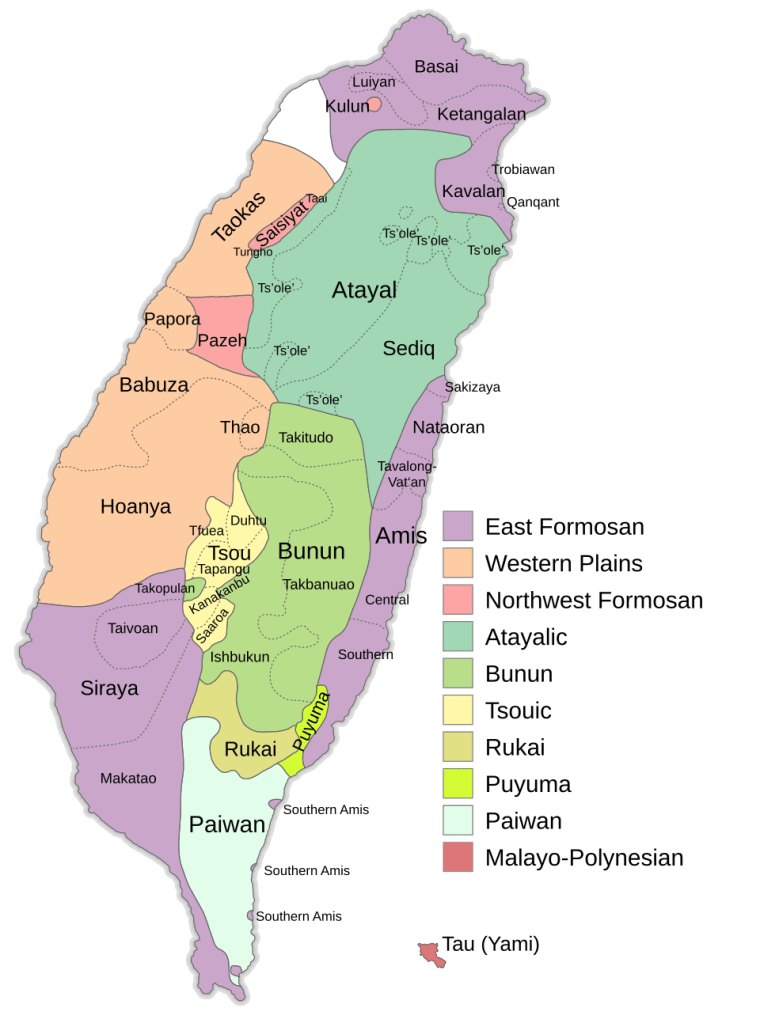
( wikipedia.org )
the central mountains & lowland areas.
Compare this image with the maps (above)
to appreciate the geographic distribution of the indigenous population prior to the 1600’s.
( geology . com )
- wikipedia.org – Indigenous Peoples of Taiwan ( 臺灣原住民 ) @ Wikipedia . org
- wikipedia.org – List of Indigenous peoples of Taiwan @ Wikipedia . org
- wikipedia.org – Indigenous Areas of Taiwan @ Wikipedia . org
- wikipedia.org – Formosan languages @ Wikipedia . org
- wikipedia.org – Plains Indigenous Peoples of Taiwan @ Wikipedia . org
- cip.gov.tw – The Tribes of Taiwan @ The website of the Council of Indigenous Peoples (CIP) of the Island of Taiwan
- Here is a guide to Home Pages at the CloudBridge Project website for the “recognized” Indigenous People Groups on the Island of Taiwan:
- The Amis People (阿美族) – The Amis People call themselves “The Pangcah”, which means “people” & “kinsmen”. The Amis are the largest indigenous ethnic group on the Island of Taiwan. They are distributed mainly: (i.) in the east of the Central Mountain Range; (ii.) on the coastal plain of the eastern Taiwan counties of Hualien & Taitung; and (iii.) on the Hengchun Peninsula in southern Pingtung County. Click here for the Home Page for the Amis People at the CloudBridge Project: Amis – 阿美族
- The Atayal People (泰雅族) – The Atayal People are the most widespread ethnic group in Taiwan. The Atayal are distributed in the mountainous areas of seven counties and cities of central & northern Taiwan: New Taipei City, Taoyuan City, Hsinchu County, Miaoli County, Taichung City, Nantou County & Yilan County. According to the Atayal language, “Atayal” means “people”, “real people”, or “kinspeople”. Click here for the Home Page for the Atayal People at the CloudBridge Project: Atayal – 泰雅族
- The Bunun People (布農族) – The Bunun People live on both sides of the Central Mountain Range of the Island of Taiwan at an elevation of 500-1,500m. The Bunun ethnic group lives at the highest elevation of all of Taiwan’s indigenous peoples. Currently, the population of The Bunun People is about 59,500 people (as of January 2020),. According to the Bunun migration legend, the Bunun ancestors originally settled on Yushan (Jade Mountain) and its northern peaks. They gradually moved down the mountain but experienced pressure from other populations, and retreated again to the mountains in eastern Taiwan. Currently, the Bunun People are distributed in Nantou County, Hualien Country, Taitung County, Taoyuan & Kaohsiung City. Click here for the Home Page for the Bunun People at the CloudBridge Project: Bunun – 布農族.
- The Hla’alua People – 拉阿魯哇族 – The Hla’alua people are an indigenous people of southern Taiwan. They are also referred to as The Saaroa People. They live in three villages in Kaohsiung City. The group attained official recognition from the Taiwanese government in June, 2014 under the name Hla’alua as the 15th Indigenous People Group of Taiwan. Previously, the group was considered to be a subgroup of the Tsou people. They call themselves “Hla’alua,” but the meaning of this term is unknown. It is said that Hla’alua ancestors “originally lived in Hlasʉnga in the east with the dwarves”. Hla’alua society practices endogamy, which is the custom of strictly marrying only people with the same ancestors in the same clan. The clans are patrilineal and are called “lamaisa” or “hlipakuamia”, In a 1950 survey, there were 24 Hla’alua clans. Today, only 18 Hla’alua clans survive. Click here for the Home Page for the Hla’alua People at the CloudBridge Project: Hla’alua – 拉阿魯哇族.
- The Kanakanavu People (卡那卡那富族) – The origin of the name for The Kanakanafu (Kanakanavu) People has not been recorded or passed down orally. However, it is possible to interpret the word meaning. It’s root “-navu” is almost identical to the root of the Kanakanafu word for “bamboo”. The prefix “ka-” has the meaning of “to live in or belong to.” Therefore, some members of the Kanakanafu people have speculated that when the Kanakanafu people gradually formed a settlement, they probably lived in the bamboo forest area, and to distinguish themselves from other groups, they called themselves “Kanakanafu”, meaning: “the people who live in or belong to the bamboo forest area.” The “Household Registration List” of 1647 from the Dutch colonial period records a community called “Kanavu” (pronounced “Khulao” in Hokkien) with 37 households and 157 people. Records also show that the Kanavu chieftain participated several times in local meetings convened by the Dutch regime & had interactions with neighboring ethnic groups. For a long time, the Kanakanafu and Laarua tribes, along with the Tsou people in Chiayi County & Nantou County, were collectively referred to as the “Tsou tribe.” However, due to significant language differences that made communication impossible & the fact that each of the three groups has its own historical imagination, origin legends, festivals & traditional social structures, the government of the Republic of China on the Island of Taiwan officially recognized them as independent ethnic groups in 2014, after the Kanakanafu & Laarua tribes applied for “name rectification.” Today, most of the Kanakanafu people are Christians. Although their population is small, they are divided into different denominations, including Presbyterian, Seventh-day Adventist, Catholic & the Pentecostal True Jesus Church. The population of the Kanakanavu People is presently estimated at 400-500 persons. Click here for the Home Page for the Kanakanavu People at the CloudBridge Project: Kanakanavu – 卡那卡那富族.
- The Kavalan People (噶瑪蘭族) – The Kavalan (Kebalan) people settled in the northeast of the Island of Taiwan on the Lanyang Coastal Plain of Yilan for generations. After a violent uprising of the Indigenous Tribes against the Qing Dynasty rulers in the late 1800’s, the Kavalan People hid among the Amis People, another indigenous tribe, for over a century. In recent years, the Kavalan People have begun a name rectification movement and The Kavalan People were officially recognized as one of Taiwan’s Indigenous People groups in 2002. The Kavalan People call themselves “kavalan”, meaning “mankind living in the plain area”. According to legend, the earliest Kavalan people came from islands in the South. In the early 19th century, they began to migrate to the coastal areas of present-day Hualien & Taitung Counties. Currently, the Kavalan population has about 1,492 people (as of January 2020). Click here for the Home Page for the Kavalan People at the CloudBridge Project: Kavalan People – 噶瑪蘭族.
- The Paiwan People (排灣) – The ancestral settlements of The Paiwan People are on the North & South sides of Mt. Dawu, located in the southern section of the Central Mountain Range across Pingtung &Taitung counties. The present-day Paiwan villages are distributed in an area with Dawu Moutain in the north, the Hengchun Peninsula in the south, the town of Fanliao in the west, and districts of Taitung City in the east. Despite engaging in business activities with the outside world since the time of the Dutch colonization & the Qing dynasty in the 1600’s, the Paiwan have preserved their rich ethnic culture and customs. The Paiwan People are famous for their carving & pottery art. The dissemination of Western religions on the Island of Taiwan in recent decades has increased the number of Christian converts in the tribe, and churches are seen in every community. Today, the Paiwan has a population of around 102,700 people (as of January 2020). Click here for the Home Page for the Paiwan People at the CloudBridge Project: Paiwan – 排灣.
- The Puyuma (Pinuyumayan) People (卑南族) – The traditional homeland of the Puyuma People is in the southeastern portion of the Island of Taiwan, on the Coastal Plain of Taitung County. There are two distinctn lineages in the ancestral origin of The Pinuyumayan People: “bamboo-born” and “stone-born”. The “bamboo-born” are the people of the Pinuyumayan tribe, while the “stone-born” are the people of the Zhiben tribe. The other tribes of Pinuyumayan can trace their development from these two tribes after an early period of migration & resettlement. The Pinuyumayan people were a powerful ethnic group before the 17th century. The Sakuban (leader) was respected by all tribes. It is said that the Sakuban led 72 tribes from different ethnic groups in eastern Taiwan, with influence extending from Hualien in the north to Hengchun in Pingtung County to the south. During the Japanese colonization beginning at the end of the 19th century, the Pinuyumayan were ethnologically called the “Pinuyumayan” because they had eight tribes, known as the “eight-tribe indigenous people”. Although the Pinuyumayan people settled in the plains area of Eastern Taiwan with various other ethnic communities, they have maintained their traditions, culture & lifestyle. Pinuyumayan witches are famous among ethnic groups for their powerful magic. As of January, 2020, the Pinuyumayan population is estimated at about 14,500 persons. Click here for the Home Page for the Puyuma People at the CloudBridge Project: Puyuma (Pinuyumayan) – 卑南族.
- The Rukai People (魯凱族) – The Rukai people inhabit both sides of the south of the Central Mountain Range, in lands situated in Kaohsiung City, Pingtung County & Taitung County. Click here for the Home Page for the Rukai People at the CloudBridge Project: Rukai – 魯凱族
- The Saisiyat People (賽夏族) – The Saisiyat People, also spelled Saisiat, inhabit Western Taiwan, overlapping the border between Hsinchu County & Miaoli County. They are divided into the Northern Branch (Wufong in the mountainous Hsinchu area) and the Southern Branch (Nanzhuang & Shitan in the highlands of Miaoli). Their language is also known as Saisiyat. Each branch has its own dialect of the Saisiyat Language. Click here for the Home Page for the Saisiyat People at the CloudBridge Project: Saisiyat – 賽夏族
- The Sakizaya People (撒奇萊雅族) – According to Sakizaya legend, ancestors of this ethnic group settled in the Hualien Plain after migrating to eastern Taiwan from overseas. Their name appeared in the Dutch and Spanish records in the 17th century. When the Qing government of the Chinese Emperor began cultivating eastern Taiwan and the mountain area in the late 19th century, the Sakizaya People forcibly resisted. Many in the Sakizaya community were injured or killed, the community migrated, and the language & culture were hidden for 100 years. This severely impacted the Sakizaya cultural heritage. Many of the Sakizaya have lived & interacted closely with the Amis people since then, and culture of the Sakizaya people has become gradually indistinct from that of the Amis People. Today, most Sakizaya people have settled in Hualien County. Many tribespeople have migrated in recent years to the Taipei metropolitan area for work or education. Today, the Sakizaya population numbers about 985 people. Click here for the Home Page for the Sakizaya People at the CloudBridge Project: Sakizaya – 撒奇萊雅族.
- The Sediq People (賽德克族) – The Sediq people are distributed in the mountainous areas in central Taiwan. They are characterized by their weaving culture & facial tattoos. Sediq people uphold Gaya (the ancestral rules) as their code of living, and they value the worshipping rituals of ancestral spirits. Currently, the Sediq population has about 10,500 people as of January 2020. Click here for the Home Page for the Sediq People at the CloudBridge Project: Sediq – 賽德克族.
- The Truku (Taroko) People (太魯閣族) – According to legend, the Truku (Taroko) ancestors arrived in southwestern Taiwan in boats (“rowcing”, literally meaning “driftwood”, meaning “boat”) from South Asia in the prehistorical period. After landing onshore, they settled in the area of the Coastal Plain from Taichung south to Tainan. They were subsequently defeated by the Plains Indigenous Peoples in a conflict, and were forced to migrate to the mountain areas in central Taiwan. Through generations, they have migrated to 17 places. Eventually, they arrived is what is today’s Nantou County. The Truku people called this place “Deluwan” (“Trukuo Truwan”). It is a plateau formed by three river valleys: Ayug Lqsan, Ayug Busi & Ayug Brayaw. At Trukuo Truwan, the Truku people gradually developed their “collective historical memories” and “communal life experiences”. During the 17th to the 18th century, the Truku (Taroko) people penetrated the Central Mountain Range in Hualien County to the east to build their homeland. From the 17th century to the 19th century, the Dutch people, Japanese people & the Republic of China (Taiwan) government called the place & the people “Daruko” or “Truku”. Under the influence of Japanese Kanji, the name became Romanized as “Taroko (Truku)”. The Truku lands are located in what is today’s Nantou County, covering three river valleys, known as Tru Ruku (three living places) in the Truku language. After combining the two “ru” sounds, it became the sound “Truku”. The Truku (Taroko) people have a significant weaving & face-tattooing culture. In 2020, the Truku population was about 32,300 persons. In 2004, the Truku People were officially recognized as one of the Indigenous People Groups of Taiwan. called the Truku people. Click here for the Home Page for the Truku (Taroko) People at the CloudBridge Project: Truku (Taroko) – 太魯閣族
- The Thao People (邵族) – The Thao People mainly reside in Nantou County. The name “Thao,” means “people”, and was introduced by Japanese scholars during the Japanese colonization in the late 1800’s. It is said that the ancestors of the Thao people originally settled on the coastal plain along the western coast of the Island of Taiwan, in the vicinity of Chiayi and Tainan. When entering the Central Mountain Range during hunting, they accidentally found a rare white deer. After chasing it for days, the white deer jumped into the Sun Moon Lake. The Thao hunters stopped and found that Sun Moon Lake was a fertile place with abundant fish, and the surrounding lands were suitable for farming & hunting. They subsequently brought other Thao people to settle in the area around Sun Moon Lake. The Thao People were previously classified as a branch of the Tsou people. But due to the significant differences in language, religion & life ceremonies, the Thao People have pursued rectification of their cultural status. IN 2001, the government formally recognized the Thao ethnic group as the 10th indigenous group. As of 2020, the Thao population is approximately 800 persons. Click here for the Home Page for the Thao People at the CloudBridge Project: Thao – 邵族
- The Tsou People (鄒族) – The Tsou (Cou) people call themselves “Tsou”, meaning “people”. According to the Tsou legend, after creating the Tsou & Maya peoples with the maple leaf, the Great God Hamo created the peoples of the coastal plain with the leaf of the bishop wood (Bischofia javanica). Then, the Tsou people gradually migrated to the present location, in areas of high elevation around Alishan Mountain in Chiayi County. As of 2020, the population of The Tsou People is approximately 6,700 persons. In addition to the mountainous location around Alishan, some Tsou people have settled in Nantou County and further south in Kaohsiung City. Click here for the Home Page for the Tsou (Cou) People at the CloudBridge Project: Tsou – 鄒族
- The Yami (Tao) People (雅美族) – The Yami (Tao) people settled on Lanyu (“Orchid Island”) in Taitung County. According to the Yami (Tao) migration legend, their ancestors resided on the Batanes Islands in the northern Philippines, which are locarted to the south of the Island of Taiwan. Click here for the Home Page for the Yami (Tao) People at the CloudBridge Project: Yami (Tao) – 雅美族
THE “LOCALLY RECOGNIZED” PEOPLE GROUPS
- In Taiwan today, there are sixteen groups of Indigenous Peoples (原住民族), that have been officially recognized by the national government & included in legal protections and policies under the “Indigenous Peoples Basic Law” and related laws. These groups have formal legal status, are represented in the government’s Council of Indigenous Peoples (CIP), and enjoy rights related to culture, language protection, education, and political participation.
- In addition to these sixteen officially-recognized groups, there are other groups often described as “locally recognized” or seeking recognition—particularly among the Plains Indigenous Pingpu People (平埔族群). These groups do not yet have full national recognition under the current national Indigenous Peoples laws. Local governments have begun to acknowledge these groups at local levels or support their recognition efforts. Civil society has used the term “locally recognized” for People Groups that are “recognized” in local cultural contexts but not yet fully incorporated into national law. The term is not defined by a specific national statute but reflects political and cultural acknowledgment pending legal change.
- These groups are also listed as “locally recognized peoples” in research & community documentation, distinguishing them from the sixteen groups that are officially recognized & from other unrecognized groups. Most of the “locally recognized” groups are part of the Plains Indigenous Peoples (Pingpu People – 平埔族群). These are indigenous groups that historically lived in Taiwan’s lowland regions and have been excluded from official recognition in past government policies. There are three principal examples: (i) The Makatao People; (ii) The Siraya People; and the Taivoan People.
- In 2022, Taiwan’s Constitutional Court ruled that the Pingpu People Groups have the right to recognition as Indigenous Peoples and ordered the government to amend relevant laws to enable that recognition to proceed. The Indigenous Peoples Basic Law and Status Act in Taiwan are being revised to implement the Constitutional Court’s decision. This process aims to: (i.) Provide a legal pathway for Pingpu groups to gain official recognition at the national level; (ii.) Ensure equality of rights with the currently recognized sixteen groups; and (iii.) Address culture, language, land & identity rights through formal legal recognition.
- Source: IWGIA.org
- The term “locally recognized” currently serves as a bridge category reflecting cultural identity acknowledged at local/community levels while broader national legal recognition is still pending. Here is a guide to the Home Pages at the CloudBridge Project for the three “locally recognized people groups”.
- Makatao – 平埔族 (山脚人) – The Makatao People (also written “Makatau” or “Makattau”) are an indigenous people native to Taiwan. The Makatao People originally settled in lowland areas of Kaohsiung in Southern Taiwan. There was a later migration south to Pingtung and then east to Taitung in the early 19th century due to the influx of Chinese immigrants. Makatao villagers of the coastal plain area of Pingtung refer to themselves in the Taiwanese Hokkien language as “山脚人” which means “people living at the foot of the mountain” or in Taiwanese Mandarin they call themselves “平埔族”, which means “plains tribe'”. Click here for the Home Page for the Makatao People at the CloudBridge Project: Makatao – 平埔族 (山脚人).
- Siraya – 西拉雅族 – The Siraya People are an indigenous ethnic group on the Island of Taiwan. The Siraya settled in the flat coastal plains of the southwest & southeast parts of the island, in the area of present-day Tainan County & Taitung County. The Siraya are Plains Indigenous peoples, meaning occupants of flat coastal regions rather than mountain areas. Like other indigenous peoples of Taiwan, they are Austronesian peoples. The name “Taiwan” (historically “Tayoan” – 臺員) is generally thought to have been derived from the Siraya language, which is an Austronesian language. The Taivoan & Makatao People Groups used to be considered Sirayan communities but are now classified as independent peoples based on recent linguistic discoveries, cultural features & self-identification. Click here for the Home Page for the Siraya People at the CloudBridge Project: Siraya – 西拉雅族.
- Taivoan – 大武壠族 – The Taivoan People (or Tevorangh People) are an indigenous ethnic group that originally settled in the hill areas around Tainan. The Taivoan People historically called themselves Taivoan, Taibowan, Taiburan or Shisha. The Taivoan People used to be classified as a subgroup of the Siraya People, but scholars now regard the Taivoan People as a separate indigenous ethnic group according to 17th century documents. The first missionary to Dutch Formosa, George Candidius, wrote in 1628 that there were eight tribes around modern-day Tainan, and “the most remote village is Tefurang (Tevorangh), which lies between the mountains”. In 1694, an Officer of the Ming Dynasty recorded the first Chinese record of Tevorangh. Both records show the location & living environment of a tribe in the mountainous area of Taivoan or Tevorangh, compared to the Siraya & Makatao – the two indigenous peoples with a close relationship to the Taivoan – who inhabit the lowland only. According to some scholars, the current number of Taivoan People should exceed 20,000 persons, based on the records during Japanese rule of Taiwan. This would give the Taivoan People the rank as the second-largest non-status group of indigenous people in Taiwan, after the Makatao. Some scholars propose that the name of the island “Taiwan” actually came from the name of the Taivoan People, as the pronunciation of “Taivoan” is similar to “Tayovan”, the people whom the Dutch met around the coast of present-day Tainan. In addition, the Taivoan established a settlement called “Taiouwang”, which is the only indigenous community whose name resembles the pronunciation of the word “Taiwan”. Click here for the Home Page for the Taivoan People at the CloudBridge Project: Taivoan – 大武壠族.
THE “UNRECOGNIZED” PEOPLE GROUPS
- The main challenges currently facing all groups of Indigenous Peoples on the Island of Taiwan are: (i.) their rapidly disappearing cultures & languages; (ii.) encroachment by outsiders onto their traditional lands; (iii.) the denial of their rights; and (iv.) the exclusion of specific groups of Lowland Indigenous Pingpu People (平埔族群) from formal recognition by the government of the Republic of China on the Island of Taiwan.
- For decades, Siraya, Pazeh, Kaxabu, Taokas, Babuza, Hoanya, Papora, Ketagalan & other groups of Indigenou Peoples have been excluded from the sixteen officially recognized tribes. In 2022, Taiwan’s Constitutional Court ruled that these Pingpu groups have the right to recognition as Indigenous peoples and ordered the government to amend relevant laws to enable that recognition.
- Plains Indigenous Peoples are known as Pingpu People (平埔族群). They have traditionally made their home in the lowland regions of the Island of Taiwan, and not in the mountain areas which are inhabited by the Highland Indigenous Peoples. The Plains Indigenous Peoples consist of anywhere from eight to twelve individual groups, or tribes, rather than being a single ethnic group. As of 2012 there were 80,000 persons on the Island of Taiwan who could be identified as Plains Indigenous people, and a total of 200,000 people are estimated to be descendants of the Plains Indigenous Peoples.
- The Plains Indigenous Peoples are part of the Austronesian family of origin, which is separate from the Han Chinese. Beginning in the 17th century, Plains Indigenous Peoples have been heavily influenced by external forces from Dutch, Spanish & Han Chinese colonization of Taiwan. This ethnic group has since been extensively assimilated with Han Chinese language & culture. In many cases, the cultural identity of the indigenous communities on the Taiwan coastal plain is very dificult to distinguish from Taiwanese Han people.
- The indigenous groups currently seeking official recognition & awaiting government approval as “Recognized Peoples” under Taiwan’s legal framework are listed below:
- The Arikun People (阿立昆) are a group of Austronesian indigenous people living in the regions of the western plain & central basin of the Island of Taiwan. The Arikun (sometimes spelled “Arukun”) People along with the Lloa People used to be classified as a subgroup of The Hoanya People. In the 19th century, the Arikun people were invited by indigenous people living in Nantou County to migrate there, along with other plain indigenous peoples from western Taiwan. At the present time, many of the residents of the eastern & southeastern parts of Puli in Nantou County are descendants of Arukun people. Click here for the Home Page for the Arikun People at the CloudBridge Project: Arikun – 阿立昆.
- The Babuza People (巴布薩族) live primarily in Changhua County. The Babuza are included within the Plains Indigenous People Group (Pingpu People Group – 平埔族群) but are not currently officially recognized by the government of the Republic of China on the Island of Taiwan. Click here for the Home Page for the Babuza People at the CloudBridge Project: Babuza – 巴布薩族.
- Hoanya (洪雅)
- The Kaxabu (or Kahabu) People (噶哈巫族) are a group of Plains Indigenous People in central Taiwan. The Kaxabu People are closely related to the Pazehn People. They are known for their distinct Austronesian culture and endangered Kaxabu language, which is a dialect of Pazeh. The and their significant Sinicization, leading to them often being unrecognized by Taiwan’s government despite active cultural revitalization efforts, including their unique “Azem” festival and collaborative projects for language preservation.
- Ketagalan (凱達格蘭
- The Lloa People (羅亞族 or 魯羅阿族) are a group of Austronesian indigenous people living in three counties on the southern coastal plain of Taiwan: Yunlin, Chiayi & Tainan. The Lloa People have been previously classified together with the Hoanya & Arikun as a single group, but this grouping has been rejected by some scholars & by the indigenous people themselves.
- The Makatao People (平埔族; also 山脚人 or 馬卡道) – The Makatao People (also written as “Makatau” or “Makattau”) are an indigenous people native to Taiwan. The Makatao People originally settled in lowland areas of Kaohsiung in Southern Taiwan. There was a later migration south to Pingtung and then east to Taitung in the early 19th century due to the influx of Chinese immigrants. Makatao villagers of the coastal plain area of Pingtung refer to themselves in the Taiwanese Hokkien language as “山脚人” which means “people living at the foot of the mountain” or in Taiwanese Mandarin they call themselves “平埔族”, which means “plains tribe'”. As noted in the prior section, the Makatao People are already included in the group of “locally recognized” Indigenous People. Click here for the Home Page for the Makatao People at the CloudBridge Project: Makatao – 平埔族 (山脚人).
- Papora (拍瀑拉)
- Pazeh (巴則海)
- Siraya (西拉雅)
- The Taivoan People ( 大武壠族) – The Taivoan People (or Tevorangh People) are an indigenous ethnic group that originally settled in the hill areas around Tainan. The Taivoan People historically called themselves Taivoan, Taibowan, Taiburan or Shisha. They are known as “Tavorlong” in the Austronesian language. The Taivoan People used to be classified as a subgroup of the Siraya People, but scholars now regard the Taivoan People as a separate indigenous ethnic group based on information recorded in 17th century documents. The first missionary to Dutch Formosa, George Candidius, wrote in 1628 that there were eight tribes around modern-day Tainan, and “the most remote village is Tefurang (Tevorangh), which lies between the mountains”. In 1694, an Officer of the Ming Dynasty also wrote the first known record of Tevorangh in Chinese documents. Both records show the location & living environment of a tribe in the mountainous area of Taivoan or Tevorangh. Thus the tribe is considered to be separate & distinct from either the Siraya or Makatao peoples, which are the two indigenous peoples with a close relationship to the Taivoan, as these two groups were known to inhabit the lowland areas only. According to some scholars, the current number of Taivoan People should exceed 20,000 persons, based on the records during Japanese rule of Taiwan. This would give the Taivoan People the rank as the second-largest non-status group of indigenous people in Taiwan, after the Makatao. Some scholars propose that the name of the island “Taiwan” actually came from the name of the Taivoan People, as the pronunciation of “Taivoan” is similar to “Tayovan”, the people whom the Dutch met around the coast of present-day Tainan. In addition, the Taivoan established a settlement called “Taiouwang”, which is the only indigenous community whose name resembles the pronunciation of the word “Taiwan”. As noted in the prior section, the Taivoan People are already included in the group of “locally recognized” Indigenous People. Click here for the Home Page for the Taivoan People at the CloudBridge Project: Taivoan – 大武壠族
- The Taokas People (道卡斯)
- EASY SEARCH FOR MORE LINKS ! . . . . .
- scholar.google.com – Indigenous Peoples of Taiwan – 臺灣原住民 @ Google Scholar
- youtube.com – Indigenous Peoples of Taiwan – 臺灣原住民 @ You Tube . com
- images.google.com – Indigenous Peoples of Taiwan – 臺灣原住民 @ Google Images
* * * * *
Click here to return to the CloudBridge Home Page
for Language & Peoples of Taiwan
NOTE : This site contains links to our ”favorite” and “most useful” websites . . . but the CloudBridge Project does not endorse or guarantee any of the products or services available through the links on the pages of this website.
本站包含了我們的 “最愛” 以及 “最有用” 的網站連結,但雲橋語文計劃並不保證其連結的有效性或對其背書.
Welcome to send us an email with your thoughts or comments:
欢迎用电子邮件的方式分享您的意见和建议:
Email: CloudBridgeTaiwan @ gmail . com
LATEST PAGE UPDATE: January 12, 2026 .
最後一次更新時間為: 2026 / 01 / 12 .
Copyright ©2021 CloudBridge Project. All rights reserved.
版權所有 ©2021 雲橋語文計劃. 保留所有權利.
 CloudBridgeTaiwan