Click here to return to the CloudBridge Home Page
for the Indigenous Peoples of Taiwan
Click here to return to the CloudBridge Home Page
for Language & Peoples of Taiwan
* * * * *
Links to individual topics
for ATAYAL – 泰雅族
are displayed on this page in the following categories :
THE ATAYAL PEOPLE – 泰 雅 族
THE ATAYAL LANGUAGE – 泰 雅 語

( ontheworldmap.com )

Also shown are:
Green Island (Lu Dao) & Orchid Island (Lan Yu).
( cia.gov )

( nouahsark.com )

Alternate spellings or names:
Taroko (Truku, Seediq); Yami (Tao)
( wikipedia . org )

( geology . com )
* * * * *
THE ATAYAL PEOPLE – 泰 雅 族
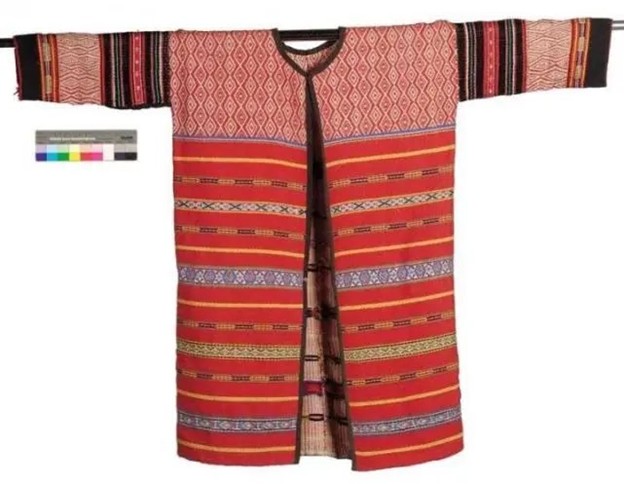
This is a traditional robe intended to be worn
by the groom at an Atayal wedding
( textilesocietyofamerica.org )
- The Atayal Indigenous People of Taiwan – 泰 雅 族
- The Atayal People (also spelled Tayal) are one of the largest & most influential Indigenous groups of Taiwan. They are known for their strong mountain culture, distinctive facial tattoo tradition & rich weaving heritage.
- The current population of the Atayal People on the Island of Taiwan is estimated at approximately 95,000 persons, which makes them one of Taiwan’s largest Indigenous groups. They inhabit primarily the Northern & central mountain areas of Taiwan in the area of the modern-day counties of Taoyuan, New Taipei City, Hsinchu, Miaoli, Taichung, Nantou & Yilan. They speak their own language which is part of the Austronesian Language Family. There are two main Atayal language groups: Squliq & C’uli’ (Ts’ole’).
- The Atayal traditionally lived in highland and forested mountain regions, adapting to steep terrain and cooler climates. Their economy is based on: (i) hunting (especially wild boar & deer); (ii) cultivation of millet, taro & sweet potato; and (iii) gathering forest products. They live in stone or wood houses, often built on slopes. The social structure consists of villages organized by kinship & alliances. Their culture places strong emphasis on communal responsibility.
- During the period of Japanese Occupation (1895–1945), the Atayal communities resisted Japanese control. They were subjected to relocation, bans were imposed on their indigenous weapons & they experienced overall cultural suppression. Accordingly, in the present day the Atayal people are often regarded as symbols of: (i.) mountain resilience; (ii.) indigenous resistance & dignity; and (iii.) a connection to Taiwan’s deep Austronesian roots. In the era since 1945, there has been gradual recognition of the Atayal indigenous rights, and a revival of their language, rituals & arts.
- Traditional Atayal beliefs center on Utux, which are ancestral spirits who influence daily life. The ancestors watch over moral behavior. The spirits are known to inhabit nature (mountains, rivers, animals).
- The Atayal have taboos which are called “Gaga”. The breaking of “Gaga” brings misfortune to individuals or the entire community. In the present day, many Atayal people also practice Christianity, often blended with the traditional beliefs.
- One notable aspect of culture among the Atayal is facial tattooing or “Ptasan”. Historically, the practice of “Ptasan” has been extended to both men and women:
Men earned tattoos through bravery, hunting success, or “head-taking”, which is no longer practiced. Women received tattoos after mastering weaving skills. Ptasan symbolizes adulthood, honor & eligibility for marriage. It ensures recognition of the individual by ancestors in the afterlife. This practice of Ptasan was greatly reduced during the period of Japanese colonial rule , but it remains a powerful cultural symbol today.
- Atayal are also known for their accomplished culture of weaving, which is among the most refined in Taiwan. Weaving was traditionally regarded as a moral & spiritual duty. Woven items carry intricate geometric patterns. Patterns and symbols convey clan identity & ancestral stories. There is prominent use of red which symbolizes vitality & blood.
- Today, the Atayal are active in: (i.) cultural revitalization movements; (ii.) Eco-tourism and serving as guides in the mountain areas; (iii.) stong promotion of Indigenous-language education; and (iv.) vigorous participation in contemporary art, music & film. Many Atayal communities balance modern life with ancestral traditions, especially during the times of festivals & traditional ceremonies.
- cip.gov.tw – The Atayal People @ Council of Indigenous Peoples website
- indigenousbridges.org
- https://tme.ncl.edu.tw
- EASY SEARCH FOR MORE LINKS ! . . . . .
- scholar.google.com – The Atayal People – 泰雅族 @ Google Scholar
- youtube.com – The Atayal People – 泰雅族 @ You Tube . com
- images.google.com – The Atayal People – 泰雅族 @ Google Images
THE ATAYAL LANGUAGE – 泰 雅 語
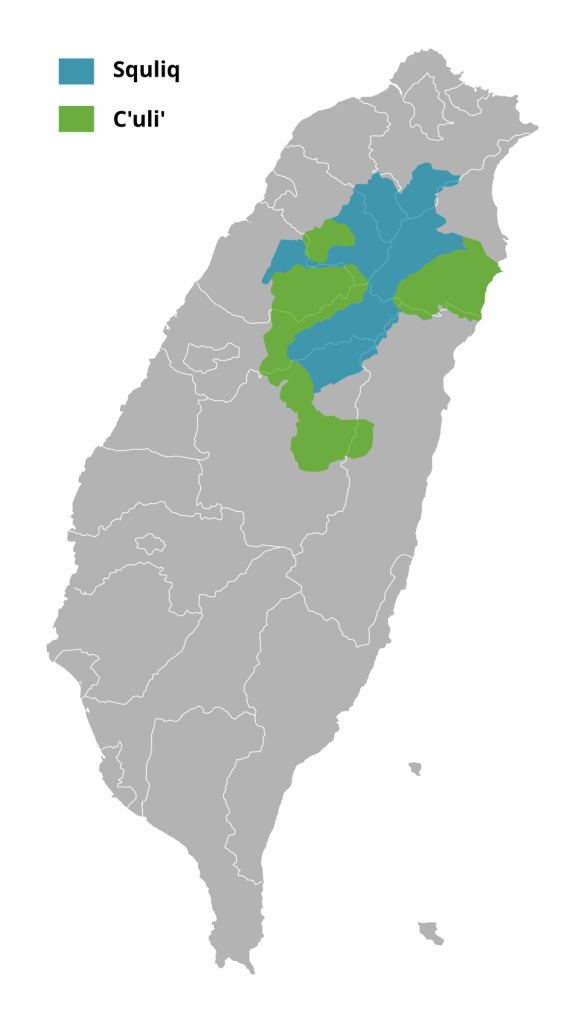
( wikipedia.org )
- The Language of the Atayal People of Taiwan- 泰雅族的語言
- The Atayal language (“Tay”) is an Austronesian language spoken by the Atayal indigenous people in the mountainous regions of northern & central Taiwan, in areas in New Taipei, Taoyuan, Hsinchu, Miaoli, Taichung, Nantou & Yilan. In parts of Yilan County, a unique Japanese creole has developed & is known as “Yilan Creole”, which is distinct from traditional Atayal language. While over 90,000 Atayal live in Taiwan, the language is considered vulnerable, with only about 35,000 fluent speakers who are found primarily among older generations.
- The Atayal Language belongs to the Austronesian language family, specifically within the Atayalic branch of the Formosan languages. The language is written using the Latin alphabet. The two main branches of the language are” “Squliq” and “Cʼuliʼ “(Tsʼoleʼ). The Cʼuliʼ branch includes distinct subdialects like Matuʼuwal & Skikun. The language is known for its high concentration of consonants, often resulting in consonant-heavy words. For example the Atayal word “slow” is “mknhuway”.
- The language is categorized as “Vulnerable” by UNESCO. While many older members of the Atayal Indigenous People Group can speak the language, the younger generation (ages 20-40) generally understand the Atayal Language but cannot fluently speak it.
- wikipedia.org – The Languages of Taiwan @ Wikipedia . org
- wikipedia.org -Atayal language – 泰雅語 @ Wikipedia . org
- joshuaproject.net – The Languages of Taiwan @ The Joshua Project website
- ethnologue.com – The Language of the Atayal People of Taiwan @ Ethnologue . com
- omniglot.com – The Online encyclopedia of writing systems & languages @ Omniglot . com
- ilrdf.org.tw – Online Dictionaries of Indigenous Languages @ Indigenous Peoples’ Languages Research & Development Foundation website
- youtube.com
- youtube.com
- thelanguagecloset.com – Languages of Taiwan – Atayal (Tayal) @ The Language Closet website
- https://en.wikipedia.org
- https://www.youtube.com
- EASY SEARCH FOR MORE LINKS ! . . . . .
- scholar.google.com – The Language of the Atayal People – 泰雅族的語言 @ Google Scholar
- youtube.com – The Language of the Atayal People – 泰雅族的語言 @ You Tube . com
- images.google.com – The Language of the Atayal People – 泰雅族的語言 @ Google Images
* * * * *
Click here to return to the CloudBridge Home Page
for Indigenous Peoples of Taiwan
Click here to return to the CloudBridge Home Page
for Language & Peoples of Taiwan
* * * * *
NOTE : This site contains links to our ”favorite” and “most useful” websites . . . but the CloudBridge Project does not endorse or guarantee any of the products or services available through the links on the pages of this website.
本站包含了我們的 “最愛” 以及 “最有用” 的網站連結,但雲橋語文計劃並不保證其連結的有效性或對其背書.
Welcome to send us an email with your thoughts or comments:
欢迎用电子邮件的方式分享您的意见和建议:
Email: CloudBridgeTaiwan @ gmail . com
LATEST PAGE UPDATE: April 10, 2026
最後一次更新時間為: 2026 / 04 / 10
Copyright ©2021 CloudBridge Project. All rights reserved.
版權所有 ©2021 雲橋語文計劃. 保留所有權利.
 CloudBridgeTaiwan