Click here to return to the CloudBridge Home Page
for Indigenous Peoples of Taiwan
Click here to return to the CloudBridge Home Page
for Language & Peoples of Taiwan
* * * * *
Links to individual topics
for TSOU (COU) – 鄒族
are displayed on this page in the following categories :
THE TSOU (COU) PEOPLE – 鄒 族
THE TSOU LANGUAGE – 鄒 語

( ontheworldmap.com )

Also shown are:
Green Island (Lu Dao) & Orchid Island (Lan Yu).
( cia.gov )

( nouahsark.com )

Alternate spellings or names:
Taroko (Truku, Seediq); Yami (Tao)
( wikipedia . org )

( geology.com )
* * * * *
THE TSOU (COU) PEOPLE – 鄒 族
( geo.tv )
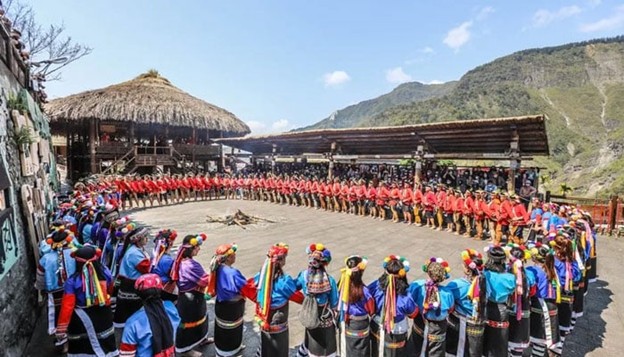
- The Tsou (Cou) Indigenous People of Taiwan – 鄒 族
- The Tsou (also spelled Cou) are an Indigenous Austronesian people of Taiwan. They have been recognized by the government of the Repubic of China on the Island of Taiwan as one of the sixteen official Indigenous Groups on the Island of Taiwan.
- The Tsou have a long history, rich cultural traditions & a strong connection to the central‑southern mountainous regions of the Island of Taiwan. The Tsou traditionally inhabit the Alishan Mountains area of Chiayi County in central‑southern Taiwan, with some communities also in Xinyi Township of Nantou County & historically in parts of Kaohsiung. The population of Tsou people is approximately 6,000–7,000 people, making the Tsou one of the smaller indigenous groups in Taiwan.
- The Tsou (Cou) language is part of the Formosan branch of the Austronesian language family. This is a group of languages native to Taiwan & ancestral to many Pacific & Southeast Asian languages. There were about 4,000 native speakersof the Tsou Language as of the early 2000’s, but the language is considered threatened, with younger generations increasingly using Mandarin.
- The oral histories of the Tsou demonstrate that the Tsou People Group is indigenous to Taiwan, with oral histories describing clan migrations & settlement formation in the Alishan highlands centuries ago. The first multi‑clan settlement, Tfuya, likely formed around 1600 CE in what is now central Taiwan. Written records from Dutch colonial times in the 17th century mention the Tsou & provide early documentation of their social structure.
- Tsou society traditionally follows a patrilineal clan system, where descent & leadership pass through male lines. The “Kuba” (men’s house) plays a central role as a communal hall for political decisions, rituals & gatherings. Women have traditionally been excluded from entering the Kuba.
- “Mayasvi” (sometimes associated with warrior rites) and agricultural festivals like millet seeding & harvest rituals are key communal ceremonies highlighting gratitude, spiritual belief & community unity among the Tsou. These events involve singing, dancing, music & offerings, and serve both social & spiritual functions.
- Traditionally, the Tsou practiced horticulture and cultivated millet, taro & other crops, along with hunting & foraging for food. Today many Tsou also participate in modern agriculture, tourism & cultural preservation activities.
- Textiles, weaving & ornamentation are important cultural expressions among the Tsou People. Traditional attire among the Tsou includes leather garments for men & cotton, silk, or brocade clothing for women, which is frequently decorated with symbolic motifs representing status & identity.
- Historically, the Tsou practiced animism — the worshipping of nature spirits & ancestors. In recent times, Christianity (especially Protestantism) has also become significant due to missionary influence in past centuries.
- There are efforts within Taiwan to preserve & revitalize Tsou language and culture. These efforts include education initiatives & establishment of local cultural centers such as the Tsou Nature & Culture Center in Alishan Township, which displays artifacts & presents exhibits on cultural traditions of the Tsou People.
- wikipedia.org – Tsou people – 鄒族 @ Wikipedia . org
- alishan.cyc.edu.tw – Social culture of the Tsou Ethnic Group @ Walking on Clouds website
- aat.teldap.tw – Tsou People @ Taiwan Art & Architecture Thesaurus
- 3people.com.tw – Tsou Ethnic Group @ Samin Exam Preparation Business Group website
- cultures-of-indigenous-peoples-in-taiwan.tw – Cultures of Indigenous Peoples in Taiwan – website
- 2025witg.com – Cou People @ World Indigenous Traditional Games website
- eslite.com – “The Tsou Ethnic Group” @ Eslite Publishing website
- airitilibrary.com – Tourism and Local Development of Indigenous Regions: A Case Study of Laiji Tribe of the Tsou People @ Airiti Library website
- indigenousday.net – The Tribes in Taiwan @ Indigenous Day . net
- commons.wikimedia.org – Tsou @ Wikimedia Commons . org
- taipeitimes.com – Tsou Aborigines rebuild, embrace organic farming @ Taipei Times website
- ab.hl.gov.tw – “Introduction to the Tribes” @ Hualien Indigenous Peoples Department website
- cbc.gov.tw
- wtfna.org
- peoplegroups.org
- youtube.com – Introduction of Tsou Tribe @ Alishan National Scenic Area @ Youtube . com
- wikipedia.org – Tsou Nature and Culture Center – 嘉義縣阿里山鄉鄒族自然與文化中心 @ Wikipedia . org
- EASY SEARCH FOR MORE LINKS ! . . . . .
- scholar.google.com – The Tsou (Cou) People – 鄒族 @ Google Scholar
- youtube.com – The Tsou (Cou) People – 鄒族 @ You Tube . com
- images.google.com – The Tsou (Cou) People – 鄒族 @ Google Images
THE TSOU LANGUAGE – 鄒 語
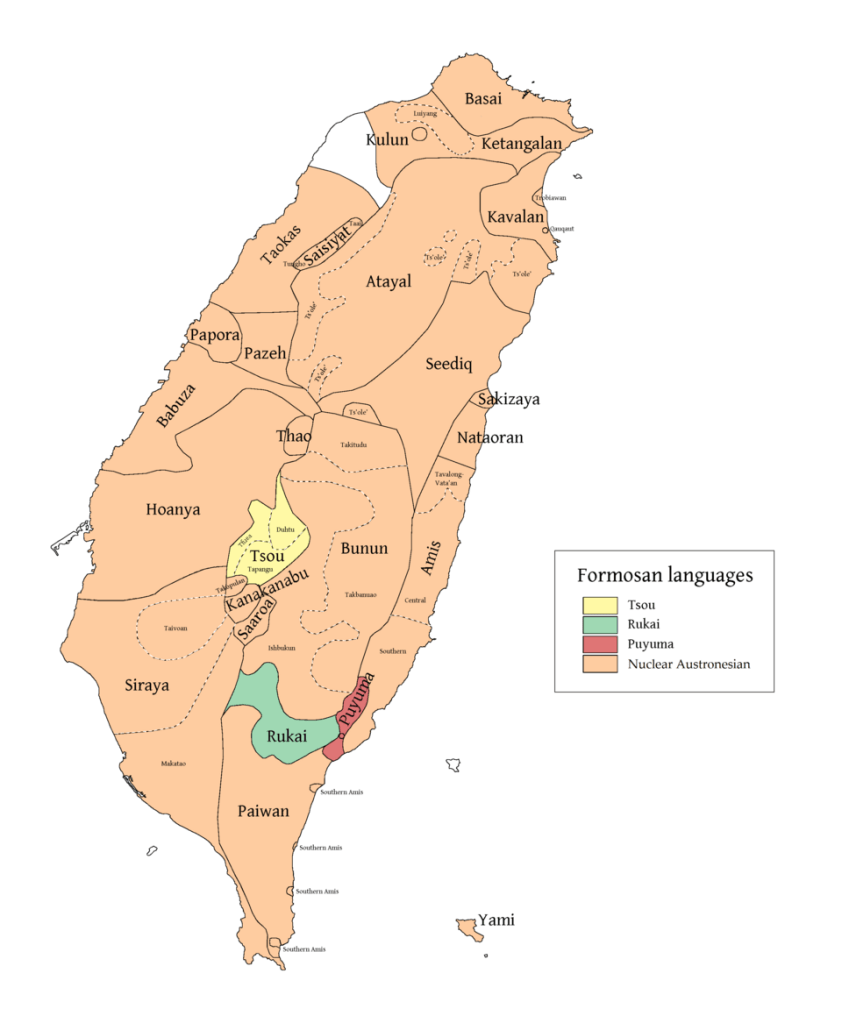
( shown in Yellow )
( wikipedia.org )
- The Language of the Tsou People of Taiwan – 鄒 語
- The Tsou language (Cou) is an Austronesian language spoken by approximately 4,000–6,500 people in the central-southern highlands of Taiwan, primarily within Chiayi and Nantou counties. It is considered a distinct primary branch of the Austronesian family, often classified under the Tsouic subgroup along with the highly endangered Kanakanavu & Saaroa languages: (i.) Dialects: The language consists of three main, mutually intelligible dialects: Tapangu (Tapaŋʉ), Tfuya (Tfuea), and the severely endangered Duhtu/Luhtu; (ii.) Status: It is an endangered language, with the majority of speakers being adults; only about 10% of young Tsou people speak it, with most using Mandarin; (iii.) Phonology: Tsou allows a large inventory of consonant clusters and has a predictable penultimate stress; (iv.) Revitalization: Efforts to preserve the language include teaching it in schools, compiling dictionaries, and translating the Bible; (v.) Vocabulary Examples: Numbers include cóni (1), eúso (2), túeu (3), sʉ́ptʉ (4), and eímo (5).
- thelanguagecloset.com – Languages of Taiwan – Tsou @ The Language Closet website
- wikipedia.org – Tsou Language – 鄒語 @ Wikipedia . org
- wikipedia.org – Tsouic languages – 鄒語群 @ Wikipedia . org
- wikipedia.org – Formosan languages – 台灣南島語 @ Wikipedia . org
- youtube.com – Austronesian Language Introduction – Tsou Tribe @ Youtube . com
- youtube.com – Tsou phrases @ Endangered Language Alliance @ Youtube . com
- omniglot.com – Tsou alphabet & pronounciation @ Omniglot . com
- omniglot.com – How to count in Tsou Language @ Omniglot . com
- ethnologue.com – Dashboard for Tsou Language @ Ethnologue . com
- ling.sinica.edu.tw – “A Discripitive Study of the Tsou Language” @ Academica Sinica Institute of Linguistics
- https://www.tcn.tw
- https://joshuaproject.net
- https://rosettapanglossia.longnow.org
- https://www2.kokugakuin.ac.jp
- https://www.ali-nsa.net/tsou-celebration
- endangeredvoices.org – Tsou Language dictionaries & Translators @ Endangered Voices . org
- https://www.omniglot.com
- EASY SEARCH FOR MORE LINKS ! . . . . .
- scholar.google.com – The Language of the Tsou People of Taiwan – 鄒 語 @ Google Scholar
- youtube.com – The Language of the Tsou People of Taiwan – 鄒 語 @ You Tube . com
- images.google.com – The Language of the Tsou People of Taiwan – 鄒 語@ Google Images
* * * * *
Click here to return to the CloudBridge Home Page
for Indigenous Peoples of Taiwan
Click here to return to the CloudBridge Home Page
for Language & Peoples of Taiwan
NOTE : This site contains links to our ”favorite” and “most useful” websites . . . but the CloudBridge Project does not endorse or guarantee any of the products or services available through the links on the pages of this website.
本站包含了我們的 “最愛” 以及 “最有用” 的網站連結,但雲橋語文計劃並不保證其連結的有效性或對其背書.
Welcome to send us an email with your thoughts or comments:
欢迎用电子邮件的方式分享您的意见和建议:
Email: CloudBridgeTaiwan @ gmail . com
LATEST PAGE UPDATE: April 09 , 2026
最後一次更新時間為: 2026 / 04 / 09
Copyright ©2021 CloudBridge Project. All rights reserved.
版權所有 ©2021 雲橋語文計劃. 保留所有權利.
 CloudBridgeTaiwan